
Components & maintenance
Garage Door Bearings, Drums and Shafts: What to Check
By HUSH Garage Door Service· Updated
On a torsion-spring door, the shaft transfers spring force to cable drums, and bearings support the rotating assembly. Noise, slack cables or uneven movement need diagnosis. These parts work under load, so identifying a symptom does not make adjustment safe.
What do the shaft, drums and bearings do?
They connect the torsion springs to the lifting cables. The shaft turns, the drums collect or release cable, and the bearings support the rotating assembly. The components must work together while the door travels.
Here is the role of each part:
| Part | Role | What an inspection needs to establish |
|---|---|---|
| Torsion shaft or tube | Transfers rotation through the assembly | Condition, alignment and correct connections |
| Cable drums | Guide the lifting cables as they wind and unwind | Correct type, condition and cable seating |
| Bearings and bearing plates | Support and locate the rotating shaft | Wear, alignment and secure supports |
These roles are described in DASMA’s sectional-door specification, section 9.3. The linked edition is an older technical reference used here for component functions, not a claim about the current applicable standard for your installation.
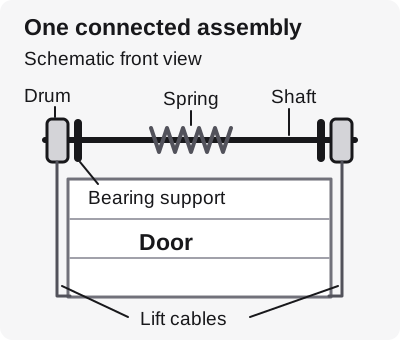
Some doors use an extension-spring system instead. If the hardware above your door does not resemble this arrangement, begin with the garage door parts glossary rather than ordering a torsion-system part by guesswork.
What is a garage door torsion tube?
A garage door torsion tube is the hollow steel shaft above the door that turns both cable drums as the springs unwind. It is the “shaft” in the table above, the springs and drums ride on it, and the bearing plates hold it up.
Many residential doors use a hollow torsion tube for garage door counterbalance. Heavier doors often use a solid shaft with a keyway, where a steel key locks each drum in place. On a Wayne Dalton TorqueMaster door the tube also hides the springs inside it, which is why a TorqueMaster break hides from view.
A bent or twisted tube shows up as one side rising ahead of the other, or cable winding differently on each drum. The tube carries the springs’ full twist, so sliding, straightening or replacing it is spring-system work. Report the symptom and leave the tube fastened.
What does a garage door bearing plate do?
A garage door bearing plate is a steel bracket that holds a bearing and supports the torsion tube, one at each end and often one in the centre. The end plates sit on the wall beside each drum, and the centre plate anchors the springs.
The two end bearing plates let the tube turn freely while keeping it level and in line with the drums. The garage door center bearing plate, also called the centre bracket, is where the fixed ends of the springs bolt to the wall above the door, so it resists the springs’ full twist every time the door moves.
That is why a loose centre plate, or a cracked wood pad behind it, is a reason to stop using the door. A worn end bearing tends to squeal or let the tube wobble, but as the table above notes, sound alone does not identify the part. A bearing plate on a bridge or a steel beam is a different part; on a garage door the term always means these supports.
Which symptoms mean you should stop using the door?
Stop using a door that hangs unevenly, has a loose or frayed lifting cable, or moves abnormally. Keep the opening clear. Do not repeatedly cycle it to record a better video or try to straighten it by hand.
DASMA’s damage-inspection guide directs trained technicians to check alignment, mounting attachments and slack cables. Those observations call for an assessment of the system, rather than a diagnosis from one sound.
Describe what you observed without deciding the replacement in advance:
| Observation | Useful information to report |
|---|---|
| One side rises differently | When it started and whether a cable appears slack |
| Scraping or grinding near the header | Where the sound came from during previous operation |
| Cable wound unevenly on a drum | A photo from a safe distance, with the door left alone |
| A visibly displaced shaft support | Any recent impact or repair and a clear description |
A squeak alone does not prove bearing failure. DASMA notes that springs can make noise during ordinary use in its safety guidance. For a broader symptom list, see other causes of a noisy garage door.
Why do replacement drums and shafts need matching?
Drums differ by their application and capacity. A part that fits over a shaft may still be wrong for the door’s height, cable or lift arrangement. As one example, FlexiForce’s residential drum specification lists shaft size, cable diameter, door weight and height limits separately.
Ask the technician to identify the existing drum markings and explain the replacement match. Garaga’s installation manual, printed page 14 identifies left and right drums and specifies a straight, level shaft in the system it describes. That does not make a different manufacturer’s drum interchangeable.
Changes elsewhere can matter too. Mention any new window section, added material or altered track arrangement. Those details help the technician assess whether the current hardware still suits the complete door.
Must every part be replaced when one bearing wears out?
Ask for the condition of each proposed replacement and the reason it needs attention. A damaged component can justify repair; an age estimate or an impressive-sounding part name is not a diagnosis of the remaining assembly.
DASMA’s published hardware-overhaul discussion challenges selling a whole rebuild merely because one part has failed. It also emphasizes parts tested to work together as a system. The article is historical; its old prices and lifespan examples should not be used as today’s quote.
A useful estimate separates the immediate fault, other observed damage, and optional work. Ask what checks follow the repair, including the complete door’s movement and balance. Avoid requesting a premium bearing or different shaft before the original fault has been identified.
What can you safely do before the door inspection?
Leave the spring assembly, drums, cable attachments and bearing supports fastened in place. Garaga warns against adjusting the spring system or attached parts yourself in its maintenance guidance.
Collect the door label, any existing repair paperwork, and a description of when the symptom began. Explain if the door is open, closed or stuck, so nobody expects you to move it for the appointment.
For a cable or overhead-hardware concern, ask HUSH to inspect the garage door. Describe the symptom and let the inspection determine which parts need work.