
Buying & specifications
Garage Door Headroom: Standard, Low and High Lift
By HUSH Garage Door Service· Published
Headroom is the space above the garage door opening. Low-headroom hardware fits a restricted space. High-lift hardware carries the door farther up before it turns into the garage. Each needs measurements and a compatible door, track and opener.
What does garage door headroom measure?
Headroom measures the vertical space above the opening where the door hardware must fit. A beam, pipe or finished ceiling can restrict that space. Record the obstruction as well as the measurement, so the installer knows what limits the door’s path.
Measure the opening rather than copying the dimensions of the old door. Garaga makes this distinction in its door measurement guidance. Its lift guide adds an exception: when the installed door extends above the opening, measure clearance from the top of that door.
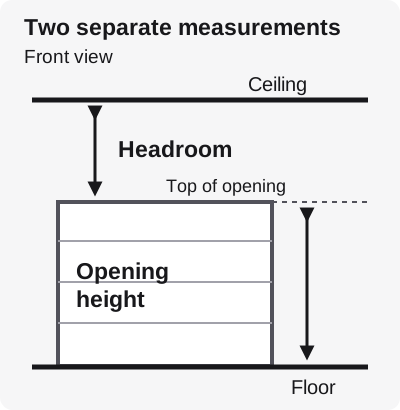
You can collect preliminary dimensions without removing hardware. Leave hard-to-reach measurements to the installer. Keep clear of a moving or damaged door and avoid placing a ladder in its travel path.
How much headroom does a standard door need?
For its standard torsion-spring arrangement, Garaga gives a general starting point of 12 inches above the door and adds 2 inches when an electric opener is used. These figures describe that arrangement. They are not a fit guarantee for every garage. See Garaga’s headroom requirements.
Track radius, spring position and opener design change the required space. A specification for another door, or a minimum quoted without its hardware details, is not enough to approve an order. Ask for the clearance drawing for the proposed combination.
How do standard lift, low headroom and high lift differ?
Standard lift turns the door back into the garage near the opening. Low-headroom hardware deals with a smaller gap above it. High lift uses more of the available wall height before the track turns back.
These are different answers to different space problems:
| Arrangement | Space problem it addresses | What to confirm |
|---|---|---|
| Standard lift | A conventional opening with room above and behind it | Track radius, spring space and opener clearance |
| Low headroom | Limited space above the opening | Exact dual-track arrangement and compatible opener |
| High lift | A tall interior where the open door should sit higher | Proposed lift height, hardware and remaining overhead clearance |
Garaga describes the available arrangements in its types of lift guide. Its low-headroom explanation shows why some systems use two tracks: the top section follows a different path from the sections below.
High lift leaves the entrance opening unchanged. If the aim is to drive a taller vehicle through it, start with the opening height and a building assessment. Raising the track inside will not remove a low header.
Does a car lift in a home garage need a high-lift door?
A car lift in a home garage usually needs a high-lift door, because a standard-lift door and its opener sit where the raised car goes. A high-lift sectional door runs its track up the wall before it turns back, which frees the ceiling space above the lift.
The opener moves too. A ceiling-mounted opener hangs in the same zone, so high-lift jobs often pair with a wall-mounted opener beside the door. Before anyone quotes, get the lift maker’s required ceiling height for your model and the height of the raised vehicle, and add both to the measurements below. A search for a Genie lift turns up aerial work platforms from Genie Industries, a different company from the Genie garage door opener brand.
Which other measurements should you collect?
Record the opening width and height, the side space at each jamb, and the clear distance back into the garage. Include the lowest obstruction along the proposed track and opener path. Garaga’s measurement guidance treats these as separate dimensions.
A useful enquiry includes:
- Opening width and height, with units.
- Space above the opening and the location of any obstruction.
- Available space on each side.
- Interior depth along both track paths.
- Photos facing the closed door from inside, plus the ceiling and current opener label.
Tell the installer what you want to gain: less overhead obstruction, room for equipment, or a replacement for an old door. Include the equipment’s dimensions when relevant. The installer can then assess the actual space you need to keep clear.
What should a lift-system assessment confirm?
It should identify the door, track, spring and opener arrangement, show the required clearances, and state any building or electrical work outside the door installation. Ask whether existing components can remain and what evidence supports reusing them.
DASMA cautions that replacement doors and old tracks may not work together; section thickness, weight, headroom and opener position all matter. Its garage door safety guidance treats the door and track as a system.
For an Ottawa replacement project, send HUSH your opening measurements and photos. Describe any high-lift or low-headroom requirement before booking so the available service and inspection scope can be confirmed.